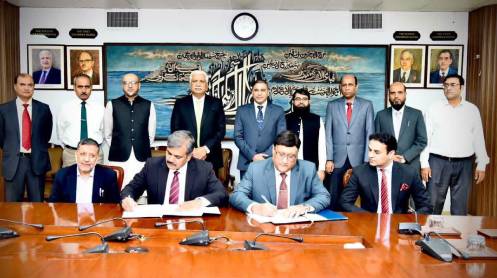
ISLAMABAD: Pakistani oil refineries began signing long-awaited agreements with a government-designated entity on Thursday that will allow them to proceed with around $6 billion in planned upgrades, moving a years-long effort to modernize the country’s aging refining infrastructure into the implementation stage.
Thank you for reading this post, don't forget to subscribe!The agreements provide the contractual framework for investments by Pakistan’s existing refineries to modernize their plants, produce cleaner Euro-V fuels, reduce lower-value furnace oil output and replace some imported petroleum products with domestic production.
The move is expected to reduce Pakistan’s reliance on imported petrol and diesel, improve fuel quality and strengthen energy security, an effort that has gained urgency as hostilities intensify in the Middle East.
Attock Refinery Ltd. (ARL) said in a regulatory filing on Thursday it had executed its agreement with Inter State Gas Systems (ISGS), which the government has designated to implement and oversee the refinery upgrade program.
“The execution of the Upgrade Agreement marks a significant milestone in the Company’s efforts to modernize and upgrade its existing refinery infrastructure, enhance operational efficiency, improve product quality, produce Euro-V standard fuels and contribute toward a more sustainable and secure energy future for Pakistan,” ARL said in its filing to the Pakistan Stock Exchange.
ARL Chief Executive Officer Adil Khattak said separately that National Refinery Ltd., Cnergyico Pakistan Ltd. and Pakistan Refinery Ltd. had also signed agreements on Thursday, while Pak-Arab Refinery Ltd., or PARCO, was expected to follow.
The agreements mark a critical step in a process that Khattak said began with the first draft of a refinery policy in December 2019, before the government approved its policy for upgrading existing refineries in August 2023.
The policy offered incentives to encourage the country’s five existing refineries to undertake major upgrades, but implementation was held up by fiscal and other issues affecting the commercial viability of the multibillion-dollar projects. It was amended in February 2024 and again in August this year before the revised policy was notified earlier this month.
Under the framework, ISGS will execute the agreements, monitor upgrade projects, manage refinery upgrade accounts, verify project milestones and administer incentive payments provided under the policy.
The five refineries — ARL, NRL, Cnergyico, PRL and PARCO — have a combined crude processing capacity of about 350,000 barrels per stream day and require substantial investment to improve fuel quality and reduce their reliance on producing furnace oil.
The government estimates the modernization program could attract around $6 billion in investment, with the projects expected to be completed within five years.
“Today’s signing, however, is not the end of the journey,” Khattak said in a statement. “It is the beginning of an even more challenging phase as the five refineries translate their commitments into financing, engineering, procurement, construction and commissioning of these complex projects within the stipulated five-year period.”
He said industry estimates showed the upgrades could eventually save Pakistan around $1.5 billion annually in foreign exchange by reducing its reliance on imported petroleum products.
Pakistan spent about $16.9 billion on petroleum imports in the last fiscal year, highlighting the country’s reliance on imported energy and its exposure to disruptions in global energy markets.
The government has accelerated efforts to strengthen domestic refining capacity this year as the US-Iran conflict has disrupted energy supplies and shipping in the Middle East and pushed up fuel costs in import-dependent Pakistan.
Petroleum Minister Ali Pervaiz Malik said earlier this year the regional conflict had highlighted the need to reduce reliance on external supply chains and strengthen domestic refining capability.
Refiners have previously said the planned upgrades are likely to require foreign financing, with Saudi Arabia, Azerbaijan and Türkiye among potential sources.